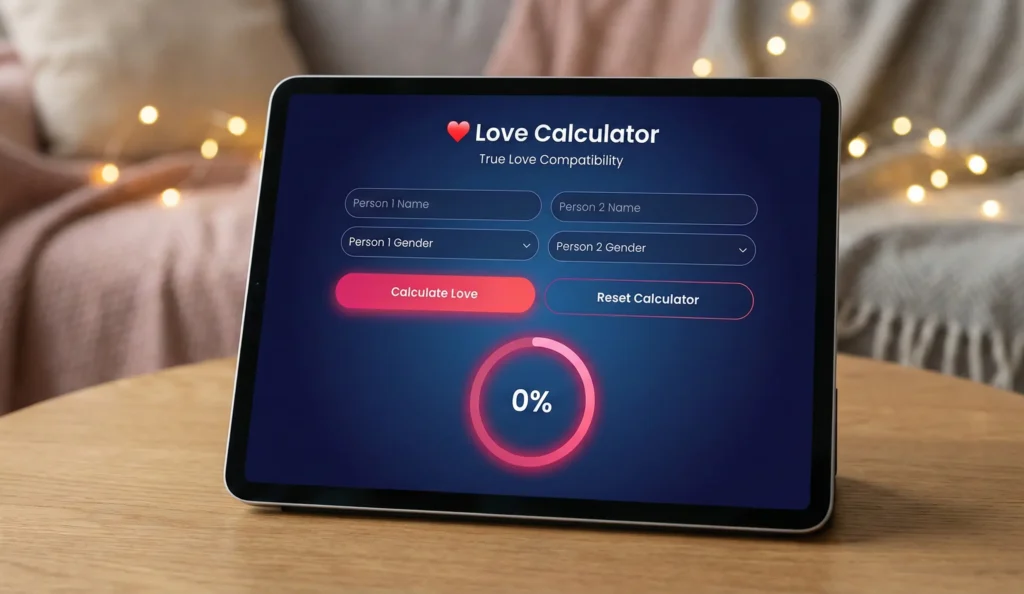
There is something oddly exciting about typing two names into a box and waiting to see what number pops up. Maybe it is a crush from school, a new romantic interest, or even a long-term partner. Whatever the reason, millions of people do it every single day. In fact, research shows that the search term love calculator pulls in over 74,000 searches every month. That is a massive number of curious hearts looking for answers online.
But here is the real question that nobody seems to stop and ask: is a love calculator just a fun little distraction, or is there actually something more meaningful going on beneath the surface?
The answer is not as simple as a percentage on a screen. This article takes a deep and honest look at what these tools really are, why people keep coming back to them, how they have evolved over the years, and what responsible expectations look like when someone decides to use one. Whether someone is a curious teenager, a young couple looking for reassurance, or just someone who stumbled across one of these tools by accident, there is something genuinely interesting to discover here.
The History Behind the Love Calculator
Long before the internet existed, people were already trying to calculate love. It happened in school hallways, on notebook paper, and during lunch breaks. The game was called FLAMES, short for Friends, Lovers, Affectionate, Marriage, Enemies, and Siblings. Two people would write their names, cross out matching letters, and count through the remaining letters to land on a result. The whole process took about two minutes, and it caused either excitement or giggles depending on who landed in which category.
That simple pencil-and-paper game is actually the ancestor of modern digital love calculators. What started as a schoolyard pastime eventually moved online in the early days of the internet, where developers built digital versions that could produce results in seconds. Name-based compatibility tools became wildly popular because they were quick, free, and required no technical knowledge from the user.
But the roots go even deeper than FLAMES. The concept of assigning meaning to names and numbers connects to Pythagorean numerology, a system that dates back roughly 2,600 years. In this tradition, every letter carries a numerical value, and those numbers can reveal patterns about a person’s character, energy, and compatibility with others. This is why many modern platforms that go beyond simple entertainment still rely on name-based inputs as part of a broader analytical process.
The journey from playground games to sophisticated digital platforms reflects how much the world has changed, but also how consistently human beings have wanted to believe that love can be measured or predicted in some way.
How a Standard Love Calculator Actually Works
Most people click on a love calculator, type in two names, hit the button, and accept whatever number comes up without ever wondering how it got there. Understanding the mechanics behind these tools is actually quite eye-opening.
In most standard entertainment-based calculators, the process works through what is called name-hashing or character frequency analysis. The tool takes both names, counts specific letters, applies a formula to those counts, and produces a number somewhere between zero and one hundred percent. There is no deeper analysis happening in the background. The algorithm is essentially doing a form of pattern matching that has very little to do with the actual personalities, emotions, or lives of the two people entering their names.
This is precisely why most of these sites include a small disclaimer somewhere on the page stating that results are meant for entertainment purposes only. The developers themselves know that the output is largely symbolic. The number you see reflects a calculation, not a cosmic truth about your relationship.
However, more advanced platforms have moved well beyond this model. Some tools now incorporate date of birth data to perform synastry analysis, which involves comparing astrological charts across more than ten different planetary positions. Others bring in specialists who apply numerological principles to derive a result that carries actual reasoning behind it, rather than just a random output dressed up in a colorful interface.
Why People Are So Drawn to These Tools
The popularity of the love calculator has never really faded. If anything, it has grown stronger with the rise of social media. People share their results on TikTok and Instagram. Friends challenge each other to try different combinations. Couples compare scores and laugh or argue about what the number means. It has become a social activity as much as a personal one.
Research into why people use these tools reveals a few consistent patterns:
Seeking validation is one of the most common reasons. When someone has strong feelings for another person, a high compatibility score feels like confirmation. Even though the person knows on some level that the algorithm is simple, seeing a big number on the screen gives an emotional lift.
Belief in destiny also plays a significant role. Studies suggest that roughly 69 percent of people believe in the idea of soulmates or a predestined romantic path. For these individuals, a love calculator feels less like a game and more like a glimpse into something meaningful.
Curiosity drives a huge portion of users. Approximately 78 percent of people who use these tools say they do so simply out of curiosity or for fun. There is no deep emotional investment. They just want to see what the tool says.
Social entertainment rounds out the picture. Groups of friends use calculators together, testing different combinations and reacting to the results. A prank calculator, for example, is specifically designed to produce funny or unexpected outputs that people can share for a laugh.
None of these motivations are wrong or naive. They are genuinely human responses to a tool that taps into some very universal emotional experiences.
Entertainment vs. Something Deeper: Where the Line Falls
Here is where the conversation gets genuinely interesting. For decades, the love calculator has been firmly planted in the entertainment category. That is still largely true. But a new generation of platforms is starting to blur that line in meaningful ways.
Traditional calculators offer a number. Advanced platforms offer a reason behind the number.
Consider the difference between receiving a 73 percent compatibility score with zero explanation and receiving that same score alongside a detailed breakdown of why certain astrological placements create tension between two people, while others create deep attraction. The second experience is fundamentally different. It gives the user something to reflect on, discuss, and actually apply to their understanding of a relationship.
This evolution has given rise to platforms that combine the accessibility of a fun digital tool with the depth of professional guidance. Instead of relying solely on an automated algorithm, some services connect users with real specialists in astrology and numerology who can evaluate a match using established analytical frameworks. These specialists look at planetary positions, birth chart alignments, and numerological patterns to produce results that carry genuine insight rather than random output.
The key distinction to keep in mind is this: a standard entertainment love calculator is designed for fun and should be treated as such. It is not a scientific measure of relationship success, and the people who build these tools are generally the first to say so. However, when a platform explicitly states that it uses human expertise or verified methodology, the experience can shift from pure entertainment into something that resembles genuine relationship guidance.
What Real Relationship Compatibility Actually Involves
Part of what makes the love calculator conversation so fascinating is the contrast between what these tools measure and what relationship science actually says about compatibility.
Real compatibility between two people involves layers that no simple algorithm can capture.
Emotional compatibility is perhaps the most important factor. It refers to how two people process emotions, handle stress, and respond to each other’s inner experiences. Couples who feel emotionally accepted by their partners tend to experience deeper trust and longer-lasting bonds.
Communication quality is another critical factor. Relationship research consistently shows that the way two people talk to each other and resolve disagreements is one of the strongest predictors of long-term satisfaction. A couple with excellent communication can navigate almost any challenge. A couple with poor communication will struggle even when everything else seems right.
Shared values matter more than shared interests. Two people can enjoy completely different hobbies and still build a deeply fulfilling partnership. What tends to create real problems is when fundamental values around family, finances, or personal growth are misaligned.
Trust and respect are the foundation beneath everything else. These qualities cannot be calculated. They are built slowly through consistent behavior, honest communication, and genuine care for another person’s wellbeing.
None of these factors show up in a name-hashing algorithm. That does not make the love calculator useless. It just means that the tool operates in a completely different space than real relationship science. The calculator can spark a conversation. It cannot replace the years of shared experience that build an actual relationship.
The Role of Astrology and Numerology in Compatibility Tools
One of the more interesting developments in the love calculator space is the growing integration of astrological principles and numerology into what would otherwise be simple entertainment tools.
Astrology has been used to understand human personality and relationships for thousands of years. When applied to compatibility, it typically involves comparing the birth charts of two individuals to identify where their planetary energies harmonize and where they clash. This process, known as synastry, looks at placements like Venus for love and romance, Mars for passion and drive, and the Moon for emotional needs and instincts.
Numerology operates on a different but equally ancient framework. Based on the Pythagorean tradition, every name and date of birth carries a numerical vibration. By reducing names and dates to their core numbers, practitioners believe they can identify patterns that reveal character traits, life paths, and compatibility between individuals.
When these frameworks are applied by trained specialists rather than automated algorithms, the results can offer a level of depth and personalization that standard calculators simply cannot match. The percentage becomes meaningful because it is tied to specific, explainable factors rather than a randomized output.
That said, it is important to maintain realistic expectations. Even the most sophisticated astrological analysis is one lens among many. It can be a genuinely insightful tool for self-reflection and relationship exploration, but it works best when combined with honest communication and real-world experience rather than used as the sole basis for major decisions.
The FLAMES Calculator and Other Fun Variations
Beyond the standard name-based tool, the love calculator world includes several entertaining variations that deserve a mention.
The FLAMES calculator remains one of the most popular. It takes two names, removes matching letters, and uses the remaining count to cycle through the six categories until one remains. The result tells you whether the relationship is destined to be a friendship, a romance, an affectionate connection, a marriage, an enemy situation, or a sibling-like bond. It is playful, fast, and incredibly shareable, which is exactly why it has survived for generations.
Age gap compatibility tools take a different approach by looking at life cycles and long-term alignment based on birth years. These tools explore whether two people are at compatible stages of life, which is a genuinely useful consideration even outside of a purely entertainment context.
Love-Hate calculators explore the tension between attraction and friction in a relationship. Rather than providing a purely positive score, these tools acknowledge that many meaningful relationships involve both deep connection and real challenges. This balanced view is actually more realistic than calculators that only ever produce cheerful results.
Prank calculators are designed specifically for social sharing. They produce surprising or absurd results that are meant to make people laugh rather than reflect anything real about the relationship. These are purely fun and are generally understood as such by everyone who uses them.
How to Use a Love Calculator Responsibly
Given everything explored above, what does responsible use of a love calculator actually look like? Here are a few grounded guidelines.
1. Treat it as a starting point, not a verdict: A high score is not proof of a perfect relationship, and a low score is not evidence that two people should give up on each other. Use the result as a conversation starter, not a final answer.
2. Understand what kind of tool you are using: There is a meaningful difference between an entertainment calculator powered by a simple algorithm and a platform that uses astrological or numerological analysis by real specialists. Knowing which one you are using helps set appropriate expectations.
3. Do not make major decisions based on a calculator result: Whether to pursue a relationship, end one, or take a significant step together should always be based on real communication, shared values, and genuine connection, not a number generated by a digital tool.
4. Use the result to spark reflection: Even a symbolic result can prompt useful thinking. If a calculator suggests tension in a particular area, it might be worth having a conversation with a partner about that topic. The value is in the reflection it encourages, not the number itself.
5. Remember that fun is a valid reason: Not every interaction with a love calculator needs to be a serious exercise in self-discovery. Sometimes it is perfectly fine to use one simply because it is entertaining, and that is completely okay.
Why These Tools Continue to Matter in the Digital Age
The love calculator has outlasted countless other internet trends. It has survived the transition from desktop to mobile, from simple websites to sophisticated apps, and from purely local use to global social sharing. There must be a reason for that kind of staying power.
Part of the explanation is that these tools meet people exactly where they are emotionally. Whether someone is experiencing the giddy rush of a new crush or the uncertainty of a long-term relationship, a love calculator offers something that feels personal and immediate. It speaks to the universal human desire to understand romantic connection, even if the answer it provides is more symbolic than scientific.
Another part of the explanation is accessibility. These tools require nothing from the user except curiosity. No appointment, no payment, no lengthy questionnaire. Just two names and a click. In a world that is increasingly complex and demanding, there is something genuinely appealing about a tool that is simple, fun, and free.
The platforms that are thriving in this space today are the ones that have found a way to honor both sides of the equation. They respect the entertainment value that drew people to these tools in the first place, while also offering pathways to deeper insight for those who want more than a random number.
Final Verdict
So, is an online love calculator just entertainment or something more? The honest answer is that it can be both, and which one it is depends almost entirely on the platform being used and the expectations being brought to it.
For most standard tools, entertainment is the primary purpose, and that is perfectly legitimate. Fun, curiosity, and light-hearted exploration are entirely valid reasons to use any digital tool. The world needs more things that make people smile and spark interesting conversations.
For platforms that go beyond automated algorithms and incorporate real expertise, structured analysis, and genuine relationship guidance, the experience can shift into something more meaningful. When a result comes with a clear reason, a human explanation, and the opportunity for ongoing dialogue, it stops being just a game and starts being a resource.
What remains constant across all versions of the love calculator is its role as a mirror for human hope. People use these tools because they want to believe that love can be understood, that connection can be measured, and that somewhere in the relationship between two names there is a story waiting to be discovered.
Whether that story comes from a simple algorithm or a trained specialist, the desire behind it is entirely real. And that, perhaps, is the most meaningful thing these tools reveal about the people who use them.